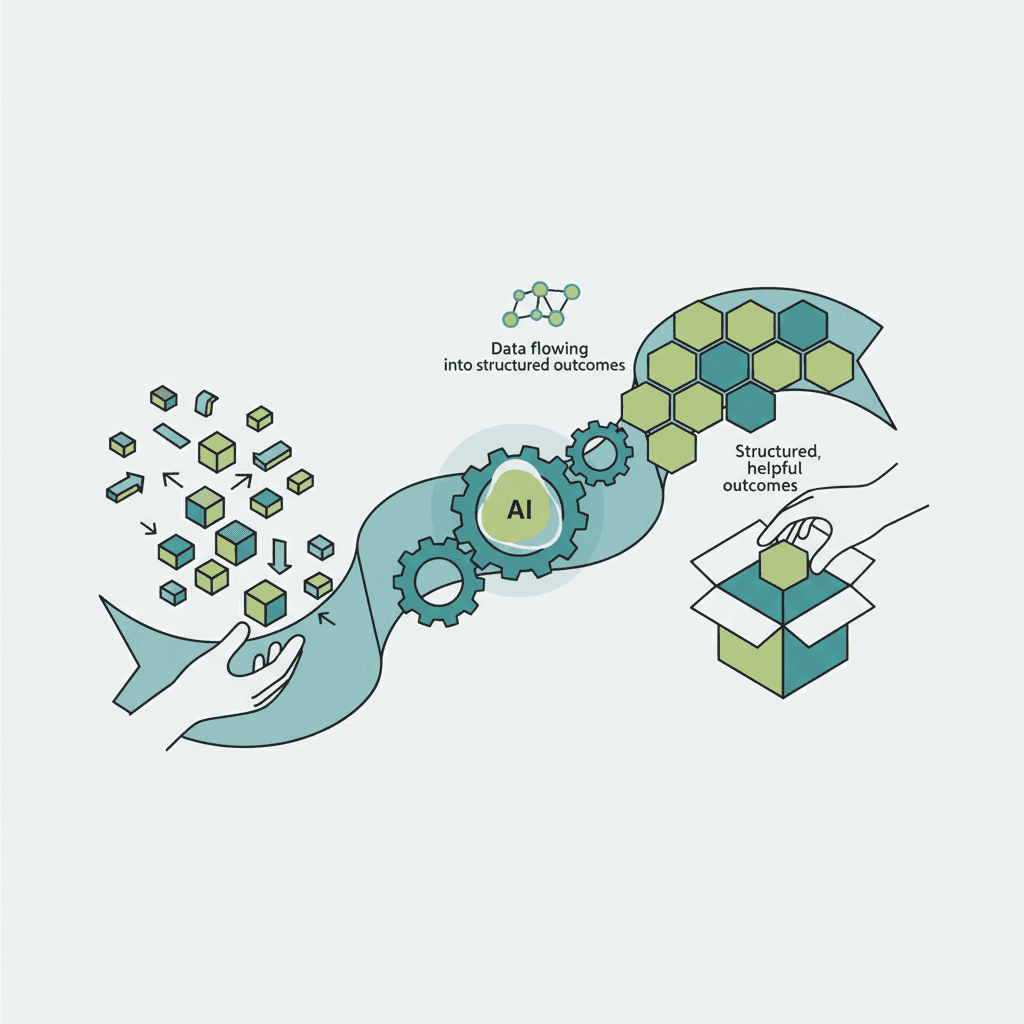
• Identify repetitive tasks: Start by pinpointing time-consuming or error-prone processes like customer enquiries or bookkeeping, and apply AI to automate these tasks for improved efficiency.
• Select suitable AI tools: Choose scalable AI platforms that align with your business size and goals, ensuring they integrate well with current systems and provide transparency in decision-making.
• Ensure team readiness: Plan for employee training and start with pilot projects to test AI tools, adjusting as necessary to minimize risks before scaling up.
• Focus on security and ROI: Prioritize data privacy from the outset and assess the potential return on investment by evaluating time saved and error reduction.
• Gain competitive advantage: Use AI to streamline workflows, enhance marketing personalization, and improve search visibility, thus reducing manual work and supporting cost savings.
Q & A: How Do I Use AI to Help My Small Business?
AI can feel promising and confusing at the same time. If you’re a brand owner, you may be weighing AI automation uncertainties, AI-powered search concerns, and what actually delivers a return.
This Q & A provides an overview of AI for small businesses in plain English. Find the question that suits your situation, whether you're seeking guidance on AI tools for business, help with brand visibility through AI, or clarity on your first steps.
Each answer is self-contained and centers on practical decisions, such as selecting tools and beginning with pilot projects. Let's begin with the initial AI implementation questions.
What are the first practical steps to using AI to make my small business more efficient?
Start by identifying repetitive business tasks that drain time. Then choose AI tools that match those needs. This is the simplest route into AI automation for business processes.
Your results depend on what you automate first and how you implement it. It also depends on your team’s readiness and how you measure changes such as time saved and reduced errors.
- Clarity on business priorities: Map your most time-consuming or error-prone processes first. This can include customer enquiries, bookkeeping, inventory management, or data analysis. Then focus on where AI can add the most value.
- Choosing the right tools: Pick a scalable AI platform that fits your business size and goals. Check it works with your existing systems. Look for clear explanations of how it makes decisions when you need that clarity.
- Team engagement and training: Plan for AI employee training needs from the start. Begin with pilot projects for AI, so you can test, adjust, and reduce AI adoption risk management issues before you scale.
After your first pilot, you can review the measuring AI impact metrics and decide what to automate next.
How do I choose the right AI tools for my business needs?
Start by selecting the best AI tools for the problem you need to solve and the result you want. Focus on immediate priorities like AI for marketing automation, customer service, or smoother internal workflows.
The right choice depends on your daily needs. Consider AI tool integration criteria, how user-friendly AI platforms are for your team, and your AI security business requirements.
- Ease of adoption: If the tool is simple to use, it is easier to roll out. User-friendly AI platforms also help your team stick with it.
- Data security and privacy: Build in AI data privacy considerations from the start. You need clear controls over how data is processed, especially with customer information.
- Demonstrable returns: Check the potential ROI from AI business tools before you commit. Value can look like time saved, improved results, or fewer manual errors.
Once you have a shortlist, run a small pilot. This allows you to see real results before scaling further.
How can AI give your small business a competitive advantage?
SodaPup: Scaling a Global Pet Brand with AI-Powered Content and Lean Operations
Adam Baker built SodaPup, an American-made dog toy company, into a global brand operating in 48-49 countries without significant paid advertising by strategically deploying AI tools for content creation, product descriptions, and customer service[1]. By using ChatGPT, Synthesia, and Shopify's AI features, Baker maintained a lean team while producing professional-grade marketing materials and scaling operations across multiple continents[14].
SodaPup expanded its distribution network to nearly 50 countries with 25 active distributors, largely powered by AI-enhanced Instagram marketing and organic growth rather than traditional paid advertising[17].
By using AI tools like ChatGPT to write scripts and Synthesia to generate video templates, Adam Baker's team could create professional marketing videos and content at three times their previous speed without hiring additional staff[14].
SodaPup built a highly engaged Instagram community of over 85,000 followers through AI-assisted content creation and user-generated content strategies, turning customers into brand advocates[17].
Before
- Limited team capacity forced Baker to balance multiple roles including product design, marketing, and customer service, which threatened operational efficiency as the business grew[14].
- High costs associated with professional product photography would have strained the budget and slowed the ability to showcase diverse product variations[1].
- Time constraints prevented regular content production needed to maintain competitive presence across multiple social platforms and distributor channels[14].
After
- Implemented ChatGPT and Shopify AI to generate product descriptions automatically, which reduced manual content creation workload while maintaining SEO optimization for e-commerce[1][14].
- Deployed Synthesia and Recraft to create professional marketing videos from simple scripts, enabling rapid production of content for Instagram and social media without expensive production budgets[14].
- Integrated AI-powered chatbots and automated customer service systems through Shopify to handle inquiries 24/7, freeing the core team to focus on product development and strategic partnerships[1].
AI can give you an AI competitive advantage by streamlining key workflows and improving customer-facing work. You can also use it for AI search visibility improvement, so your brand shows up in AI-powered results.
Your progress depends on where you apply it first. It also relies on how well you integrate tools into your current systems and routines.
- Operational workflows: Focus on AI-powered efficiency gains in daily tasks. This can reduce manual work and support cost savings with AI.
- Customer and marketing work: Use personalized marketing through AI and customizing customer experiences. This supports clearer targeting and better consistency.
- Implementation fit: Your AI adoption success factors include integration capabilities, user-friendliness, and data privacy. AI accuracy and compliance matter if you handle sensitive information.
If you need help deciding what to prioritize, we can assist you with an audit and a practical roadmap at SEWO.

Optional support if you want help applying this
If you're considering how to use AI to support your small business, practical advice can be invaluable. At SEWO, we provide access to an independent AI Advisor for small businesses. This service focuses on clear, straightforward AI implementation guidance, helping you choose what fits and start with confidence.
- Get support for AI tool selection based on your goals and day-to-day work
- Receive AI business audit support and custom AI roadmap creation, so you know what to pilot first
- Get ongoing AI strategy help, plus expert AI recommendations as tools and options change
This assistance is optional. It may be suitable if you seek an AI expert clarity call and a clearer understanding of AI ROI consultation before committing time and budget.
| Category | Details |
|---|---|
| Identify Repetitive Tasks | Start by pinpointing processes that consume significant time or are prone to errors. Common tasks include customer inquiries, bookkeeping, and inventory management. Automating these can lead to improved efficiency and significant time savings. |
| Selecting AI Tools | Choose scalable AI platforms that align with your business size and goals. Examples include Zapier for workflow automation and Tidio AI for customer support. Ensure they integrate with existing systems and provide transparency about their decision-making processes. |
| Team Readiness | Plan for employee training and begin with pilot projects to minimize risks. Evaluate team engagement during these initial tests and adjust strategies based on feedback. The success of AI implementation largely depends on how prepared your team is. |
| Focus on Security and ROI | Prioritize data privacy from the beginning by selecting AI tools with strong encryption and GDPR compliance. Regular audits and evaluating vendor policies can effectively manage privacy risks, while assessing ROI involves calculating time saved and error reduction. |
| Competitive Advantage | Utilize AI to streamline workflows and enhance marketing personalization. Improved search visibility and reduced manual work can lead to significant cost savings. Focus on automating 3-5 high-impact tasks to maximize efficiency gains. |
| AI Tools Examples | Common tools include Zapier for workflow automation and ChatGPT for customer inquiries. Free or low-cost options can save small businesses between $200 to $500 monthly, making AI automation accessible without large upfront investments. |
| Addressing Common Concerns | AI excels at automating structured repetitive tasks, but it cannot replace human creativity or intuition. Instead, it should be used to handle routine work, allowing humans to focus on complex problem-solving and strategic decisions within their business. |
Conclusion
You now understand AI for business, beginning with identifying real needs and processes suitable for automation. You also know how to select AI tools that align with your goals and are user-friendly for your team.
Choose a small pilot project, measure improvements, and refine your action plan.
References
- [1] How SMBs Can Successfully Implement AI: A 5-Step Framework for Small Business AI Adoption - https://www.frameworkit.com/blog/how-smbs-can-successfully-implement-ai-a-5-step-framework-for-small-business-ai-adoption
- [2] The Ultimate Guide to AI Implementation for Small Businesses (Even ...) - https://netwoven.com/business-application/ultimate-guide-to-ai-implementation-for-small-businesses/
- [3] How to get started with AI: A beginner's guide for small businesses - https://capsulecrm.com/blog/how-to-get-started-with-ai-a-beginner-s-guide-for-small-businesses/
- [4] A Small Business Guide to AI | CO- by US Chamber of Commerce - https://www.uschamber.com/co/run/technology/small-business-ai-guide
- [5] AI for small business - https://www.sba.gov/business-guide/manage-your-business/ai-small-business
Case Study Sources - How Do I Use AI to Help My Small Business? Practical Steps and Tips
- [1] uschamber.com - https://www.uschamber.com/technology/artificial-intelligence/ai-is-transforming-small-business-a-colorado-success-story
- [14] youtube.com - https://www.youtube.com/watch?v=lxrdPmzFX9I
- [17] treptalks.com - https://treptalks.com/interviews/adam-baker-of-sodapup
Be the first to share your thoughts on this article.